
There is a sharp contrast between the somewhat shabby status
of Avondale and the well-kept grounds of Glenwood.
Glenwood was added to the Michigan Register of
Historic Places in 1989 and the National Register of Historic Places in
2010. In 2015 Glenwood became a
certified arboretum thanks to its massive oaks, beautiful maples, and gnarled
catalpa trees.
Strolling through Glenwood you’ll find a historical
who’s who of the people who made Flint. Even if you don’t know Flint history
you’ll recognize street, business and building names on the gravestones. “Among the stones you’ll
find lumber barons, civil war veterans, two Governors, one Lt. Governor and
pioneers of the carriage and automobile industries.”
This is just a sample of the names of Glenwood’s
residents that now grace Flint locations: William S Ballenger Sr (Ballenger Hwy),
Josiah W Begole (Begole Street), Henry H. Crapo (Crapo Street), J. Dallas Dort
(Dort Hwy), Williams M. Fenton (the city of Fenton), Charles Stewart Mott (Mott
Community College, Mott Children’s Health Center, The Mott Foundation, Robert
J. Whaley (Whaley House), and James H. Whiting (The Whiting).
“Not many places in a city collect history the way
Glenwood has for Flint. A walk around the grounds will transport visitors into
all the adventure, triumph, and occasionally, all the heartache of past eras.
No chronicle reads quite as eloquently as the graves at Glenwood. “Look out
over this cemetery at the names on the headstones,” says Peter. “They are the
names of the streets we drive on, the parks we play in, and the schools we send
our kids to.” Glenwood is the home of the city’s past, giving to the living a
tranquil sanctuary as it gives to the dead a resting place.” (My
City Magazine October 1, 2013)
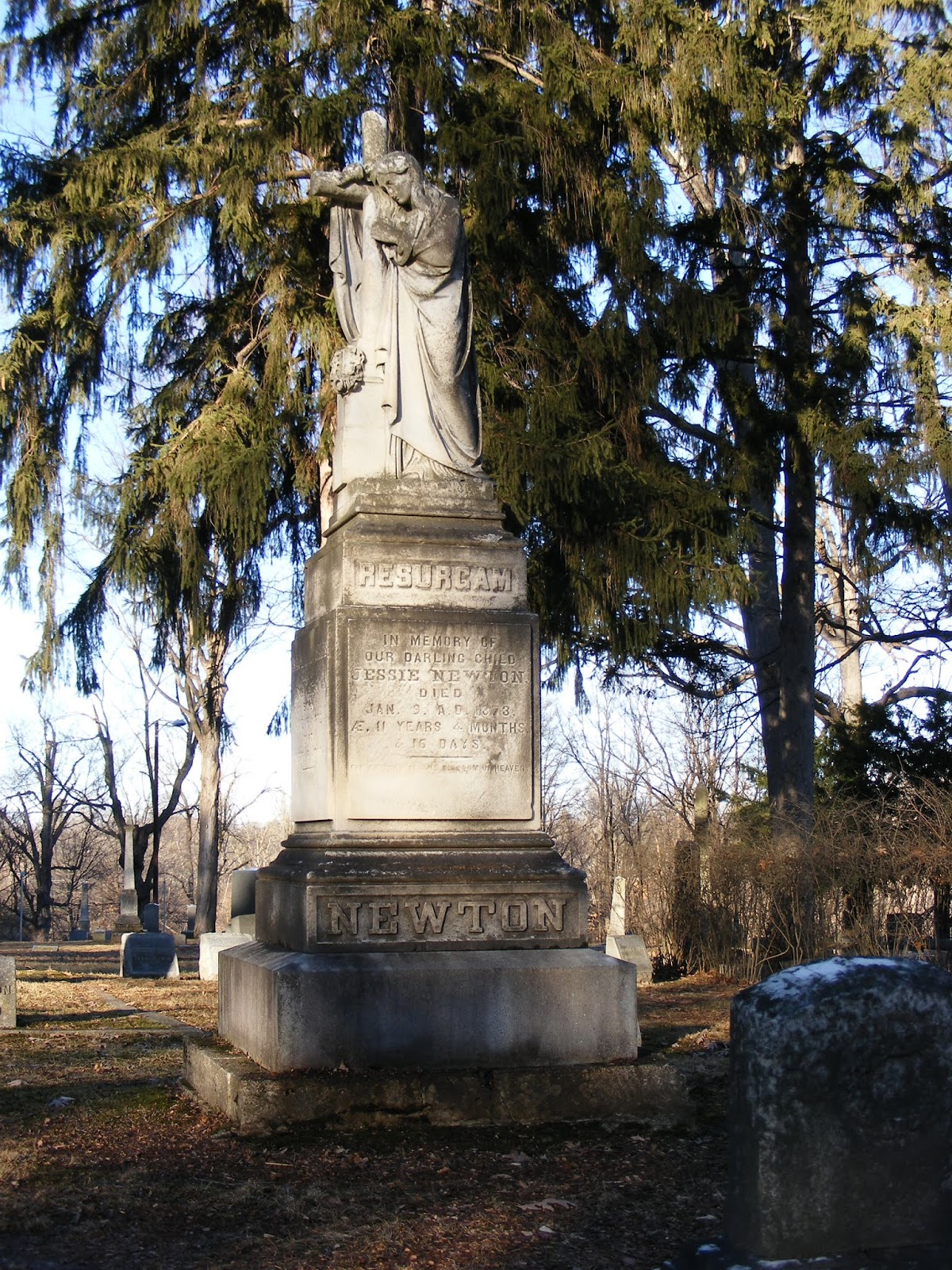
Glenwood is peaceful and mysterious. Ornate stones
full of imagery make us wonder who these people really were, who loved them,
what were their lives like?
Headstones full of symbology draw taphophiles. “An
obelisk broken in half represents a young woman taken before her time; a stone
in the shape of a wooden stump marks the final resting place of not only a
person but a line, the last to carry a surname. Many headstones have what
appear to be sheets draped over them, representing the thin veil between life
and death.” (MLive
September 19, 2014)
One mysterious set of gravestones even had former
Glenwood caretaker, Peter
Lemelin perplexed. “The three gravestones bear the names
Patterson, Pierce and Hubbard. The men they mark are not related, but all have
the same kind of headstone, made from the same kind of stone, and they're in a
perfect triangle. Perfect triangle, three exact stones, you'd
think that was an accident? I don't have an answer to it. " (The
Flint Journal July 16, 2013)
I visited Glenwood on a hot sunny day in July, not a
living soul in site other than a few chipmunks and other furry critters seen
scampering into the bushes as we walked the grounds.

Our first stop was at the large mausoleum.


It looked as though someone had recently broken into the large mausoleum…or something had broken out. In the front of the building a board was laying on the ground in front of an open window. On the side of the building slats were sticking out from the window in peculiar manner as if something had torn through them and pushed out from the inside. It was very odd.


It looked as though someone had recently broken into the large mausoleum…or something had broken out. In the front of the building a board was laying on the ground in front of an open window. On the side of the building slats were sticking out from the window in peculiar manner as if something had torn through them and pushed out from the inside. It was very odd.
Did Glenwood have a zombie outbreak? Perhaps a
vampire rising from their burial tomb? Or just Flint teenagers trying to get a
peek inside? My daughter tried to look inside the dark depths of the mausoleum
but we didn’t have a flashlight and no one was brave enough to get too close to
that open window.


A family crypt behind the large mausoleum was quiet
and elegant, other than a shattered cherub lying next to a column on the
cement.

Such odd things made you pause and wonder…did this just fall and break, landing here in this position? Or is there a deeper meaning to this shattered visage of innocence?

Such odd things made you pause and wonder…did this just fall and break, landing here in this position? Or is there a deeper meaning to this shattered visage of innocence?
My daughter and I visited Glenwood again in the winter, this time we strolled the side of the cemetery full of Flint historical figures: Mott, Dort, Whiting, Crapo, Smith, Stockton....
On this chilly January day there was no one to be seen within the cemetery. It was a stark contrast to the bustling movement outside the gates of Glenwood where people had been walking, waiting on buses as sirens blared.
Inside the gates the city sounds were muted and the crunch of dry leaves and melody of bird song is what filled my ears.


The overwhelming sense of history here is immense and I love strolling the grounds and imagining how things were in the times when these people were alive.On this chilly January day there was no one to be seen within the cemetery. It was a stark contrast to the bustling movement outside the gates of Glenwood where people had been walking, waiting on buses as sirens blared.
Inside the gates the city sounds were muted and the crunch of dry leaves and melody of bird song is what filled my ears.




Glenwood wasn't spooky or weird however this popped up when I uploaded the photos to my computer. I circled the odd area, then in the second image I cropped it so you could see just that area.
It looks like a head is rising up out of the grave and looking at me.
This was a flat headstone. Nothing had been sitting on it and it did not have any decorative structures on top.
I was hoping to find photos of this grave in another shot from another angle but I can't match up the location in other photos.
It could be a reflection from the sun glaring off the marble surface, I don't know. It just looks so odd.
This is the camera I always use when visiting "haunted" locations and I swear it is a ghost hunter. No other cameras catch odd ghostly figures or weird glares and flares like this one does.


Then there was the stripper tree, LOL. That's what my daughter and I call it because it looks like a female form upside down doing a pole dancer pose.


Haunted Flint
Haunted America Series
Roxanne Rhoads and Joe Schipani
Publisher: The History Press
Release Date: September 2, 2019
ISBN-10: 1467143049
ISBN-13: 978-1467143042
Book Description:
Sinister Secrets in Flint’s History
Home to ancient burial grounds, unsolved murders, economic depression, and a water crisis, Flint emits an unholy energy rife with ghostly encounters.
Colonel Thomas Stockton’s ever vigilant ghost keeps a watchful eye over his family home at Spring Grove, where guests occasionally hear the thump of his heavy boots.
Restless spirits long separated from their graves lurk among the ancient stones in Avondale Cemetery.
Carriage maker W.A. Paterson’s spirit continuously wanders the halls of the Dryden Building, and something sinister and unnamed resides in a Knob Hill mansion waiting to prey on impressionable young men.
Join authors Roxanne Rhoads and Joe Schipani on a chilling tour of Flint’s most haunted locations.


